
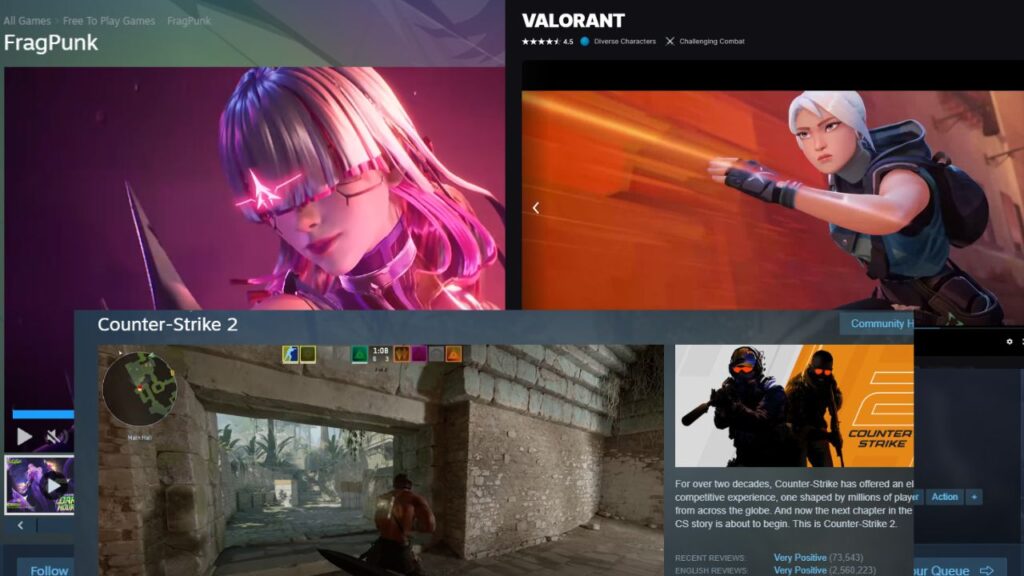
FragPunk vs Valorant vs CS2 — three games, same genre label, completely different answers to what competitive should feel like.
If you want to grind mechanics until they’re muscle memory, play CS2. If you want abilities layered on tight gunplay with a polished ranked experience, play Valorant. If you want each round to feel genuinely unpredictable — and you’re fine with a game still maturing — play FragPunk.
But the right pick isn’t that simple, because the wrong one will burn you out within a week. Here’s how to actually choose.
What Each Game Is Actually Trying to Do
FragPunk: A Card Game Disguised as a Shooter
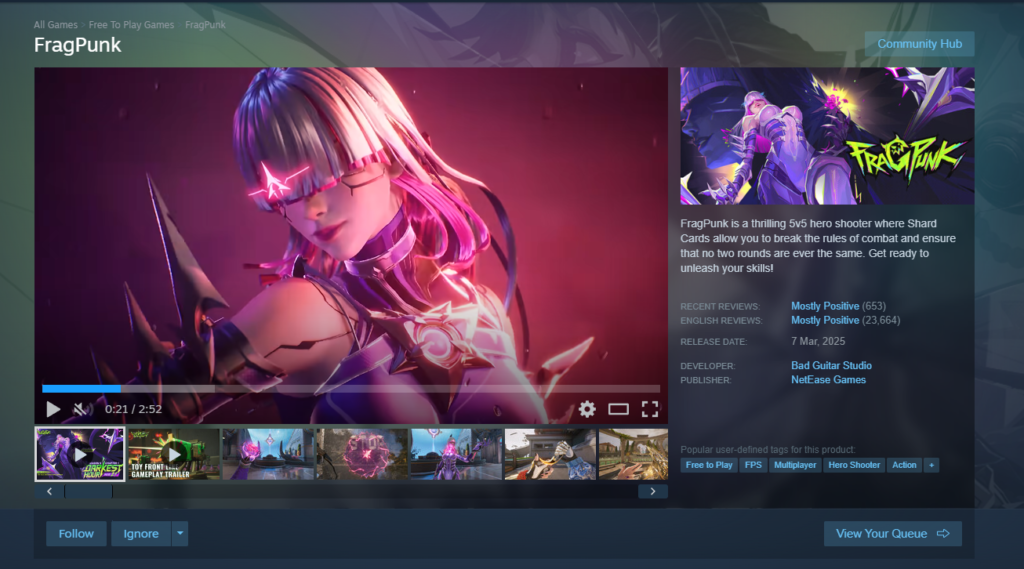
Released March 6, 2025 by Bad Guitar Studio, FragPunk is structurally a bomb-defusal game — 5v5, attackers plant the Converter, defenders stop them. You’ve seen this before in CS2 and Valorant. What you haven’t seen is the Shard Card system.
Before each round, both teams are presented with three randomly drawn Shard Cards and spend Shard Points — earned through performance — to activate them. The cards range from minor buffs to complete rule rewrites:
- Big Heads — enemy head hitboxes grow, making headshots trivially easy
- Bio-Warrior — players who die respawn as melee zombies
- Floor is Lava — the ground deals continuous damage, forcing vertical movement
- Clone Tech — your whole team can pick the same Lancer, enabling broken ability stacking
- Reaper’s Scythe — summons a wall-piercing weapon at spawn that also lets you teleport to altar points
- Throw to Plant — you can plant the Converter by throwing it into the site
In ranked play, there’s also a pick/ban phase — a card captain bans two cards per team and then drafts three. This adds a metagame layer where reading the enemy’s composition before banning matters as much as your aim.
The system was inspired by producer Chang Xin’s love of sports. He studied how rule changes in leagues like Europe’s King’s League kept viewership engaged — and applied the same philosophy to FPS rounds.
The tradeoff: The randomness that makes FragPunk fresh also makes it hard to rank on pure skill. A card like Big Heads can neutralize the aim advantage you spent months building. That’s either a feature or a deal-breaker depending on your temperament.
Valorant: The One That Hides Its Depth
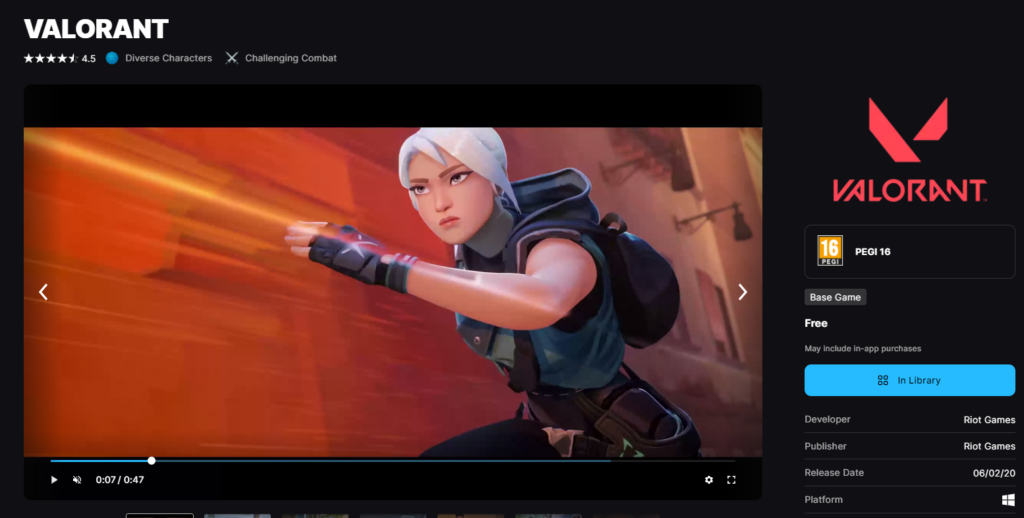
Valorant launched in June 2020 with a concept that sounds derivative — what if CS had hero abilities? — and then executed it well enough to build one of gaming’s largest competitive scenes from scratch.
Each of its 25+ agents carries four abilities (including an ultimate) that interact with the gunplay rather than replacing it. Sova’s recon dart tells you where enemies are hiding. Omen’s smokes let your team cross an open lane. Killjoy’s turret holds a site post-plant while the team clusters elsewhere. The skill expression isn’t just aim — it’s knowing which agents counter which, how to time an ultimate to win a 3v4, and where to throw a Sage wall to create a chokepoint that didn’t exist on the minimap.
Riot’s servers run at 128Hz tickrate — game state updates 128 times per second — meaning shot registration is tight and complaints about missed hits are rare. That technical investment matters in a game where head-to-head aim duels decide close rounds.
The tradeoff: Onboarding 25+ agents is overwhelming. New players who don’t understand what Fade or Harbor do will lose rounds to mechanics they don’t even recognize. The learning curve isn’t the gunplay — it’s the agent knowledge.
CS2: Where Bad Habits Have Nowhere to Hide
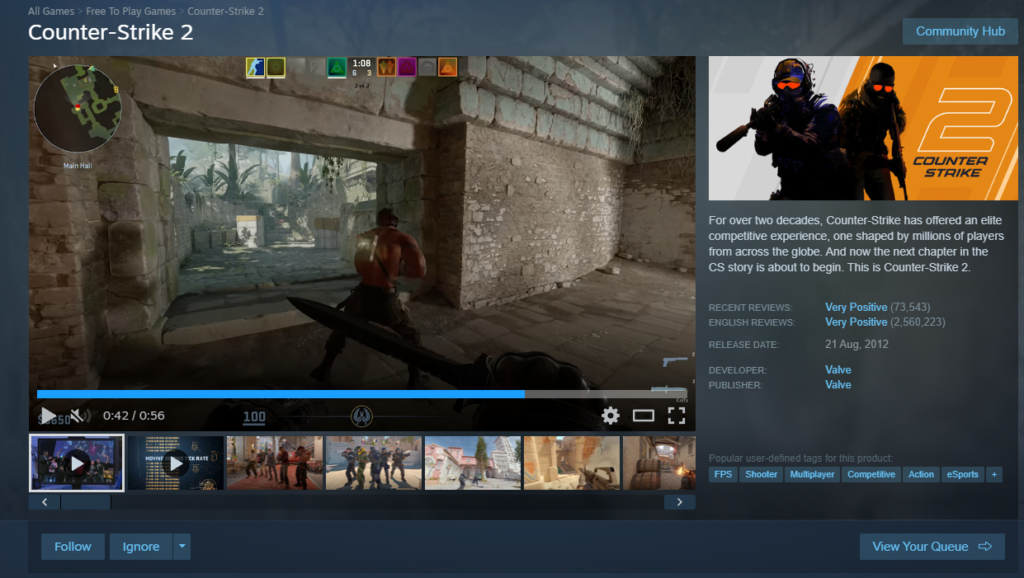
Counter-Strike 2 replaced CS:GO in September 2023, built on the Source 2 engine. No abilities. No hero picks. Every player buys from the same weapon pool each round, and the only variables are aim, movement, utility usage, and team communication.
This is either the purest competitive FPS ever made or the most punishing — depending on your skill level. The AK-47 and M4A1-S have learnable recoil patterns you spray-compensate by dragging your mouse in the opposite direction. Smoke grenades have precise pixel-level lineups memorized by pros. And unlike Valorant, where a Sage wall can bail you out of a bad position, in CS2 if you take a bad duel, you’re dead with no recovery mechanic.
Valve’s sub-tick system replaced the legacy 64Hz servers, though the change has been controversial — pro players have criticized its predictability compared to the fixed-tick model.
The tradeoff: CS2 is the highest-variance experience for new players. Your first 50 hours will consist of getting shot from angles you didn’t know existed by people who have those angles memorized from a decade of play. The ceiling is enormous. The floor is brutal.
Time to Kill — How FragPunk vs Valorant vs CS2 Actually Feels in a Duel
TTK is what separates these games faster than any feature comparison.
CS2 has extremely low TTK. An AK headshot from any range is an instant kill. An AWP anywhere on the body above the feet is a one-shot. This means positioning and the first shot matter enormously — you do not trade shots in CS2, you try to avoid trading entirely.
Valorant sits slightly higher. Body shots require more hits to kill, and some agents have shields or heals that extend effective HP. The game is still lethal by FPS standards, but it’s slightly more forgiving about the first-shot advantage.
FragPunk adds a layer of complexity here — Shard Cards can directly modify TTK mid-match. Vampire Bullet gives lifesteal on every hit. Death’s Embrace summons a Grim Reaper that executes enemies hit for the first time, dealing 75 damage to everyone in the area. One round might feel like CS2’s lethality; the next, a team sustaining through lifesteal turns it into an attrition fight.
Skill Ceiling and Who Each Game Is For
FragPunk is the easiest to get into. The card randomness deliberately neutralizes some skill gaps — which frustrates veterans but keeps newer players competitive. That said, high-ranked FragPunk requires reading the draft, building card synergies, and coordinating Lancer abilities. The ceiling exists; it’s just accessed differently.
Valorant is the most accessible path into serious competitive play. Abilities create openings that raw aim can’t, so a player with a good understanding of agent kits can beat someone with better mechanics. At Radiant level, though, mechanical skill becomes just as critical as anywhere in CS2.
CS2 is the most demanding mechanical environment in the genre. Recoil control, counter-strafing, utility lineups — these are skills measured in months, not hours. The rank distribution reflects this: most players sit at Gold Nova, and breaking into Master Guardian requires genuinely solid fundamentals. There’s no ability to bridge the gap.
Movement and Gunplay
Movement is the clearest technical split between the three.
CS2 has the highest movement ceiling. Counter-strafing — tapping the opposite direction key to instantly stop momentum before shooting — is fundamental at any rank above Silver. Bunny-hopping and crouch-peeking are real mechanics. Movement interacts directly with spread: if your character model is still moving when you click, your shot is going somewhere unpredictable.
Valorant deliberately slows movement down. You can’t accurately shoot while strafing. Crouch-walking is intentionally sluggish. The philosophy is that mobility comes from abilities — Jett’s dash, Neon’s slide — not from raw player input. This keeps gun duels focused on positioning reads rather than technique.
FragPunk is the fastest-feeling of the three, though cards can modify this in either direction. Mass Cheetah adds 15% movement speed across the board. Speed Limit punishes players for moving fast. The base feel sits between Valorant and a hero shooter like Overwatch.
What Happens When You Make a Mistake
This is the most useful frame for deciding which game fits you.
In CS2, a mistake is usually permanent for that round. You took a bad duel, you’re dead, you spectate. There’s a buy phase between rounds but no mid-round recovery. CS2 punishes and teaches through loss — you will die in the same spot repeatedly until you figure out why.
In Valorant, some agents have tools that directly address mistakes. Sage can self-heal. Skye can heal teammates. Reyna can dismiss and escape a losing fight. You can pop a Barrier Orb to close off a site when your team is caught out of position. Mistakes have more answers — which is both more forgiving and, some argue, less educational.
In FragPunk, mistakes can be recovered at the card-draft level. If your team got obliterated because the enemy ran Bio-Warrior zombies, you can ban that card next round. The game gives you structural tools to respond to what beat you, which no other tactical shooter in the genre offers.
PC Requirements: What You Actually Need to Run Each Game
| FragPunk | Valorant | CS2 | |
|---|---|---|---|
| Min GPU | GTX 1060 | GTX 1050 Ti | GTX 1060 |
| Recommended GPU | RTX 2070 | RTX 2060 | RTX 2070 |
| Min RAM | 16GB | 4GB | 8GB |
| Storage | ~30GB | ~23GB | ~35GB |
| Anti-cheat | NetEase proprietary | Vanguard (kernel-level) | VAC |
Valorant runs on almost anything — Riot’s engine is famously lightweight and the clean art style means even low-spec machines can hit 60+ FPS at reduced settings. It’s the strongest option if hardware is a constraint.
CS2 is more demanding than people expect given its age, especially at 1080p+ with high refresh rates. The Source 2 engine is more GPU-hungry than CS:GO was.
FragPunk is the most demanding of the three at equivalent visual quality. On launch it also had stability issues — crashes and high ping were documented in the first few weeks — though patches have addressed most of this.
Player Count and Community Reality Check
CS2 and Valorant both have player populations large enough that you will never notice queue time at any hour, any region, any rank.
FragPunk peaked at 113,946 concurrent Steam players on March 9, 2025 — its opening weekend — and has settled considerably since. Current Steam concurrent numbers sit in the low thousands, with the broader population spread across Epic Games and consoles (Xbox launched April 29, 2025). If you’re in a smaller region or playing at unusual hours, matchmaking quality in FragPunk can suffer.
This matters for ranked play specifically. A smaller ranked pool means you’ll face the same players repeatedly and rating inflation/deflation can be more extreme.
Monetization: What You’re Actually Paying For
CS2 skins are traded assets with real market value. You can buy, sell, and trade through Steam’s Marketplace. The cheapest skins cost under a dollar; the rarest — like the Pattern 387 Karambit Case Hardened — have sold for over $1.5 million. For most players, budget skins are cheap and plentiful. There is zero gameplay impact.
Valorant’s store rotates premium skins with unique animations, sound designs, and kill effects. Bundles run $50–$100. Nothing is tradeable. The Battlepass provides earnable cosmetics. No gameplay advantage is sold at any level.
FragPunk’s Relics system is the most complex and the one to watch. Some Relics provide gameplay-adjacent buffs, and early community concern around pay-to-win elements was loud enough that the developers addressed it in patch notes. Relics can be earned through play. Whether the balance holds as monetization evolves is an open question.
Esports Scene
CS2 Majors offer prize pools reaching $1–1.25 million, run twice yearly, and draw peak viewership in the hundreds of thousands. The pro scene is decades old with established teams — Natus Vincere, FaZe Clan, Team Vitality — recognized outside gaming.
Valorant’s VCT (Valorant Champions Tour) has become one of the most organized esports structures in any game. The 2024 Champions event drew over 1.5 million peak concurrent viewers on Twitch. Riot subsidizes teams, builds out regional leagues, and runs Game Changers as a parallel circuit for underrepresented genders — a structure no other tactical FPS has attempted at scale.
FragPunk has no organized esports structure as of mid-2025. NetEase has run community tournaments, but there is no signed roster scene, no league, and no established circuit. If esports viewership or aspiring to compete professionally matters to you, this is a real gap.
Which Game Should You Actually Play?
Stop trying to pick the “best” one. Pick the one that matches how you’re wired.
Play CS2 if: You want skill expression that’s fully yours — no abilities, no card luck, no character meta. You’re willing to lose 40+ hours before you feel competent. You want a game refined by professional play for over two decades. And you find value in knowing that if you beat someone, it’s because you were mechanically better.
Play Valorant if: You want a tactical FPS with more decision points than just aim. You care about ranked infrastructure, esports to watch, and a game that will be actively developed and balanced for years. You want the onboarding path to feel achievable even without a CS background.
Play FragPunk if: You find yourself getting bored by repetitive round patterns in other tactical shooters. You play best when the meta shifts round to round rather than match to match. You’re willing to trade peak competitive integrity for a genuinely different experience. And you don’t mind being in on something earlier rather than later.
Coming from other games? From Apex Legends or Overwatch: start with Valorant — abilities will feel familiar, gunplay is the new challenge. From CoD or Battlefield: FragPunk’s pace matches your expectations better than CS2’s deliberate rhythm. From CS:GO: CS2 is the obvious choice, but Valorant rewards transferable skills with less frustration in the early ranks.
FAQ
Can I play FragPunk solo, or do I need a team?
You can queue solo and matchmaking will build you a team, but the Shard Card system genuinely rewards coordination. A team that communicates card selections between rounds has a structural advantage over five individuals picking independently. Solo is viable in casual modes; ranked solo without communication is frustrating.
Is FragPunk dying?
The Steam concurrent numbers are low compared to the launch peak, but this is the pattern for nearly every free-to-play game that spikes at release. The console launch (Xbox, April 2025) added a player base not counted in Steam figures. Shard Cards Vol. 3 dropped in September 2025, which suggests active development. Not dead, but watch the update frequency.
Is CS2 harder than Valorant?
Mechanically, yes. CS2 requires precise recoil control, counter-strafing, and utility lineups with no ability-based recovery for mistakes. Valorant’s abilities create windows that let players compensate for weaker aim. At the highest levels, Valorant’s mechanical ceiling is nearly as demanding — but the floor is much lower in CS2.
Which tactical shooter has the best anti-cheat?
Valorant’s Vanguard is kernel-level — it runs on system startup, even when you’re not playing, which lets it catch cheats that load before the game. It’s the most aggressive implementation of the three and has a strong track record of bans. CS2’s VAC system is slower to detect new cheat software and the community has documented cheater issues in matchmaking for years. FragPunk’s anti-cheat is newer and less battle-tested.
Does it hurt your aim to switch between CS2 and Valorant?
Yes, meaningfully. CS2 requires counter-strafing — you must stop movement before shooting or your shots miss. Valorant’s movement also penalizes accuracy while strafing, but the muscle memory is built differently. Players who main CS2 and play Valorant on the side frequently report crossover errors. FragPunk’s movement is different enough that it doesn’t create the same conflict.
What’s a realistic CS2 skin budget to look decent?
A few dollars gets you a serviceable AK skin. $20–$50 gets you a knife with a real skin that won’t look out of place. The expensive skins are status symbols and investment pieces, not requirements for looking good.
Is FragPunk pay to win?
The Relics system raised pay-to-win concerns at launch, particularly around gameplay-adjacent buffs. The developers have maintained that Relics providing buffs can be earned through play rather than purchased exclusively, and patches have addressed the most egregious concerns. It’s worth keeping an eye on as the monetization model continues to evolve.